
I. A misrecognised starting point
We usually picture “thinking for yourself” like this: a person closes the door, shuts out the noise of the world, and meets the truth in a clean interior space. The picture is so deeply lodged that thinking independently has become almost synonymous with thinking alone. Yet between the two sides of that equation lies a crevasse.
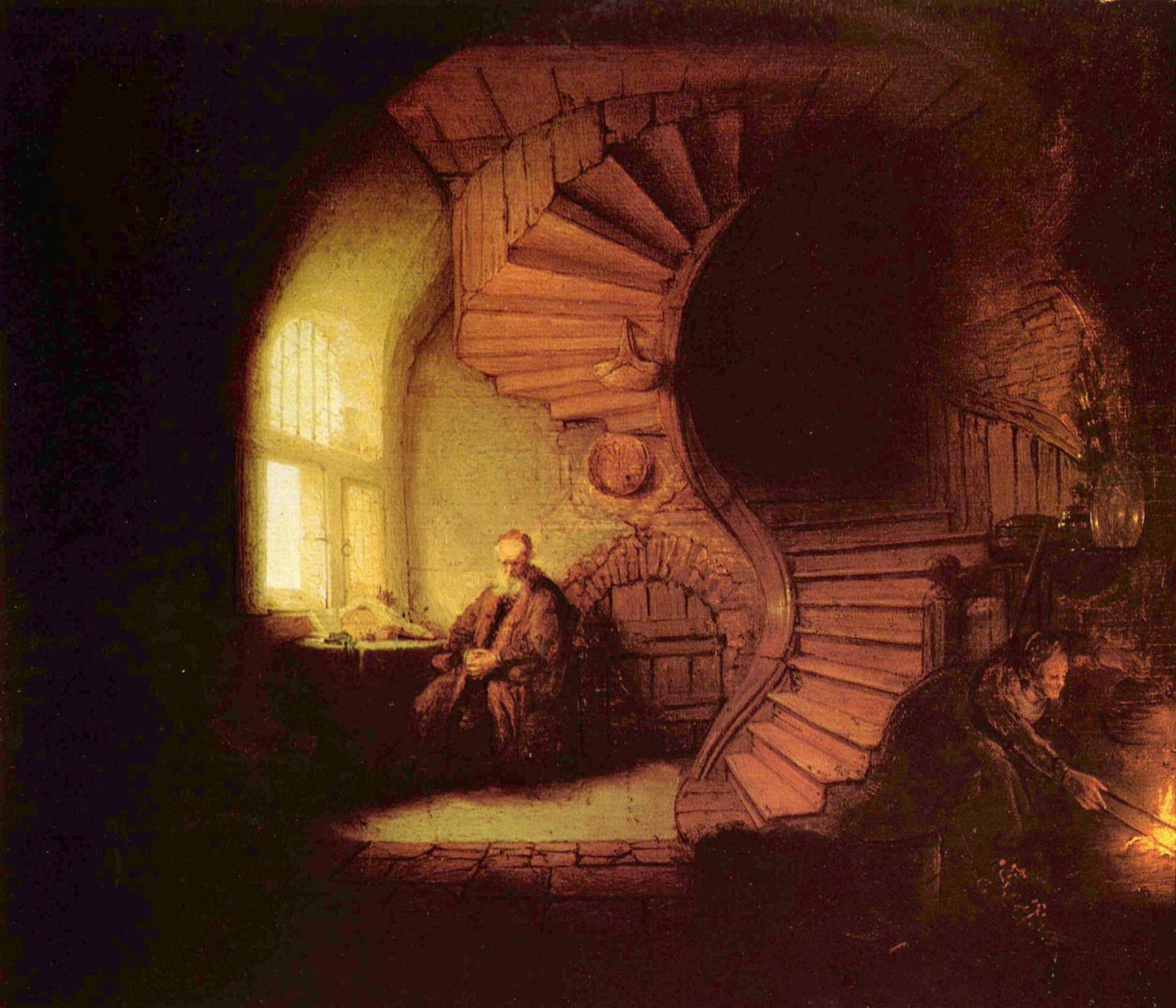
The central tension is this: independent thought demands autonomy of the subject, but the structure of thinking presupposes the presence of others. Both propositions are true, and they cannot be reconciled. What follows is an attempt to stay at that unreconciled point long enough to see the deeper terrain underneath it.
Let me begin at the most basic level.
II. Language: a tool you have never owned alone
When you “think for yourself,” what do you think with?
You think with language. With concepts. With categories. And you invented none of them.
In the Philosophical Investigations, Wittgenstein advances the private language argument: a language used by a single individual, referring only to that individual’s private sensations, is logically impossible. Meaning depends on public rules of use; outside the linguistic community constituted by other people, even the concept of “following a rule” disintegrates. You believe you are thinking alone, but every word you think with carries the historical sediment of an entire linguistic community.
What follows from this? That before you sit down to think independently, others are already inside your thought. They constitute the very medium in which you think. Each of your concepts was acquired through interaction with other people; each category bears the shaping of a particular culture and history. When you think using the word freedom, you are simultaneously deploying all the tension that a tradition running from Plato to Berlin has poured into it. You may not notice—but not noticing is not the same as it not being there.
Important as this argument is, though, it remains superficial. It tells us that the material of thought comes from others, but it has not yet reached the deeper question: does the structure of thinking presuppose others?
III. The dialogic structure of thought: Bakhtin’s insight
Bakhtin advanced an extremely deep proposition: consciousness is dialogic in its essence.
The claim is far more radical than it looks. Bakhtin does not mean merely that thinking resembles dialogue, as though dialogue were a metaphor. He means that thinking, at its most basic level of operation, is dialogue. Monological thinking is a degenerate, impoverished form—like a river cut off from its source. You may call the remainder a puddle, but it has lost whatever made a river a river.
Why? Because any meaningful thought is necessarily a response to some possible objection. When a judgement takes shape in your mind, its force comes precisely from having held its ground in a field of possible challenges. The thought “I believe X is true” intrinsically contains the shadow “someone might believe X is false.” Without that shadow, “I believe X is true” degenerates into an uninformative self-repetition.
Take a concrete case. Suppose you are alone, thinking about whether democracy is the best political system. What does that thinking look like?
You put forward a proposition (“democracy respects each person’s autonomy”), and immediately a rebuttal occurs to you (“but what about the tyranny of the majority?”), and you answer it (“hence constitutional limits on majorities”), and another doubt surfaces (“then who decides the content of the constitution? Is that not elitism?”)…
Note the structure of the process: one person is conducting a many-voiced dialogue. You have divided internally into several voices, and there is real tension and conflict among them. Your “independent thought” is structurally an internalised polyphony.
Which raises the crucial question: where do these interior voices of the other come from?
IV. The internalised other: Vygotsky’s genetic account
Vygotsky’s theory of internalisation gives a precise answer: higher psychological functions appear first between people (inter-psychological) and only afterwards within the individual (intra-psychological).
A child first learns to question, reason, and reflect in dialogue with adults. Those dialogues are gradually internalised as inner speech. The debate about democracy you conduct in your head has as its prototype the countless real conversations you have taken part in, read, or overheard. Your interior objector is a composite of every real objector you have met.
George Herbert Mead’s concept of the generalized other reaches the same phenomenon from another direction. For Mead, self-consciousness itself arises through taking the role of the other. You can scrutinise your own thoughts because you can regard yourself from the standpoint of a generalized other—and that generalized other is the internalised attitudes and expectations of the social group you belong to.
Which reveals a deep paradox: the capacity for independent thought is itself a social product. You are able to think independently of others precisely because you have already internalised others into your cognitive structure. The condition of independent thought is a prior non-independence. Autonomous thinkers are those who have successfully converted external dialogue into internal dialogue.
But does this mean independent thought is merely a derivative of social thought, with nothing irreducible or distinctive about it?
No. It is not that simple.
V. The irreplaceability of solitude
Let me invert the perspective.
Thinking in a group and thinking in solitude may both be dialogic in structure, but there is an essential difference between them. Some cognitive events occur only in solitude.
First, the endurance of deep confusion. Faced with a genuine intellectual difficulty, a group’s instinctive response is to reach for consensus quickly in order to dissolve the discomfort. That social pressure toward agreement—the Asch experiments established its power beyond argument—closes the space of thought prematurely. In solitude you can stay inside the confusion. You can allow yourself not to understand. You can tolerate cognitive uncertainty for long enough that it gives birth to something genuinely new.
When Chen Yinke insisted on “an independent spirit and a free mind,” this is what he meant at depth: the solitude independent thought requires is first of all a form of cognitive courage—the courage to refuse every ready-made answer when none of them satisfies. Under social pressure that refusal is extremely hard to sustain.
Second, freedom of non-linear association. In dialogue you must organise your thoughts according to a social logic. You have to answer the other person’s question, maintain the coherence of the topic, observe the implicit norms of conversation. In solitude your mind may leap, drift, and double back freely. You can follow a seemingly irrelevant intuition and build unexpected connections between two apparently unrelated domains. Many of the most creative breakthroughs occur exactly in this socially unconstrained association.
Kekulé, dozing before the fire, dreamed of a snake biting its own tail and grasped the structure of the benzene ring. Poincaré, in the instant of stepping onto a bus, suddenly saw the connection between Fuchsian functions and non-Euclidean geometry. These illuminations happen in solitary minds, at moments when consciousness has relaxed its social control.
Third, and deepest: facing your own ignorance. In front of others we have a near-instinctive urge to conceal what we do not know, to appear more certain than we are. In real solitude there is no audience to perform for. You can honestly admit that you do not know—and that honesty is the starting point of all genuinely deep thought. Socrates’ “I know that I do not know,” as a cognitive posture, might function as rhetoric in the crowded agora, but as an actual cognitive experience it is far likelier to occur when one is alone.
So solitude has irreplaceable value. But note a subtlety: even in these solitary moments, the other has not truly departed.
Kekulé dreamed of a snake, but he could connect the snake to the benzene ring because he was steeped in the problem-consciousness of a chemical community. Poincaré’s insight presupposed the whole tradition of mathematics. Solitude offers a particular kind of cognitive freedom, but that freedom yields meaningful results only in a mind already well filled with socially acquired knowledge. Someone who knows no chemistry can dream of any number of snakes and never arrive at the benzene ring.
VI. The real enemy of independent thought
We have arrived at a complicated picture. Let me push it one level deeper.
What I want to argue is this: the real enemy of independent thought has never been the presence of others, but the homogenisation of the others within.
Let me explain.
Every mind, as we have seen, contains a number of internalised voices. The question is whether real difference and tension exist among them.
A person may have read many books, listened to many podcasts, taken part in many discussions—but if all these sources belong to the same ideological spectrum, the same class perspective, the same cognitive style, then his interior “polyphony” is only a set of small variations on a single voice. His inner dialogue is a pseudo-dialogue. He believes he is thinking independently because he can hold a “debate” in his head, but every participant in that debate presupposes the same premises and shares the same blind spots. It is a debating society with only conservatives in the room, or a seminar at which only liberals speak: surface disagreement without fundamental challenge.
This is the cognitive version of the echo chamber. The external echo chamber has been discussed at length; the internal one is more dangerous, because it operates under the disguise of independent thought. A person can, with nobody applying any pressure at all, in complete solitude, think in a completely unindependent way.
Conversely, someone whose mind holds genuinely heterogeneous voices is conducting a fiercer collision of ideas than any external discussion, even if he never talks to anyone. Ivan Karamazov, alone, undergoes a rupture between faith and nihilism more real and more profound than any external theological debate—because in his interior both voices are his own, and he cannot simply file one of them under “the other side’s view” and refute it.
The quality of independent thought therefore depends on the diversity and heterogeneity of the internalised others. The more voices your mind holds, the more they contradict each other, the more mutually incompatible they are, the more powerful your independent thinking becomes.
Which yields a conclusion that looks paradoxical and is extremely important: to strengthen your capacity for independent thought, you need to admit *more* of the other into your interior world, not less.
VII. A topology of “thinking with others”
I can now restate the original question more precisely.
“When you think independently, do you need to think with others?” The question presupposes that thinking independently and thinking with others are two cleanly separable activities between which we might choose. But the analysis shows their relation is far more complicated than a choice.
Let me offer a framework. “Thinking with others” has at least three levels.
The first level is synchronous external dialogue. You and another person sit down and discuss a problem. This is the most superficial and most easily recognised form.
The second level is diachronic absorption of knowledge. You read others’ work, learn their theories, accept their criticism. You are not in dialogue with them in the same time or space, but their thought enters your cognitive world.
The third level is structural internal dialogue. The voices of others have become part of the structure of your thinking. You no longer need to recall what they said, because their perspective has shaped the way you see at all.
Independent thought stands in a different relation to each.
To the first level, independent thought can be temporarily detached—and at certain stages must be. The irreplaceability of solitude has already been argued. But even in detachment, the second and third levels continue to operate.
To the second level, the relation is intermittent. You need periodically to return to other people’s texts and ideas for fresh stimulus and challenge, then withdraw into solitude to digest and recombine. It is a respiratory rhythm: inhale the thought of others, transform it in solitude, exhale your own view, then inhale again. Either extreme is harmful: those who only inhale become scholars rather than thinkers; those who only exhale grow thin and repetitive.
To the third level, independent thought cannot be detached at all. The other at this level is already part of what makes you you. To detach from it is to detach from your own mind.
So the answer to the original question is: independent thought does not necessarily require the physical presence of others, but in the sense of cognitive structure it necessarily contains them. You can be alone; you cannot think alone. What you take to be your own private thought is always already a conversation whose full list of participants you have not entirely recognised.
VIII. Redefining independence
If independent thought always already contains others, what does independence mean? Should we abandon the word?
No. But we should redefine it.
The “independence” of independent thought lies not in the thinker’s isolation from others but in the thinker’s conductorship over an interior polyphony.
The metaphor is worth unfolding. A conductor does not play all the instruments. There are violins, cellos, oboes, timpani—each with its own voice and logic. The conductor’s job is neither to eliminate these different voices nor to let them go their own way, but, on the basis of listening to all of them, to decide when a part comes forward and when it recedes, and so to shape music that means something as a whole.
The independent thinker is the conductor of his own interior symphony. He has internalised many voices—philosophical, scientific, literary, from different cultures and positions—he lets them sound fully, he listens to their harmony and their dissonance, and then he makes his own judgement. That judgement is “independent” not because it depends on no other voice, but because it is an autonomous synthesis made after listening to all of them.
Three corollaries follow.
First, independent thought is a continuum of capacity, not a state you either have or lack. The richer and more heterogeneous the interior voices, the fuller and more honest the listening, the more autonomous the synthesis and the less it is dominated by any single voice—the more independent the thinking. Complete independence is an asymptote: approachable without limit, never reached.
Second, independent thought requires a particular interior quality, which I will call epistemic courage. It has two faces: the courage to let a voice you disagree with unfold fully in your mind (resisting the urge to dismiss dissent prematurely), and the courage to reach your own judgement after listening (resisting the cowardice of deferring judgement forever). The first prevents dogma; the second prevents nihilism.
Third, independent and conformist thinking differ not in their conclusions but in their process. An independent thinker may well arrive at the same conclusion as the majority, but the route ran through a genuine internal debate. Equally, someone who holds ostensibly heterodox views is not thinking independently if those views are simply conformity to a different group—systematically opposing the mainstream in order to display one’s “independence,” for example.
IX. The particular challenge of the digital age
Apply the analysis to our own moment and some unsettling things come into view.
What do recommendation algorithms do? They systematically reduce the heterogeneity of your interior voices. They track your reading preferences and give you more of the same. Their optimisation target is engagement, and the most engaging content is usually content that confirms what you already believe. The result is an interior orchestra gradually reduced to a single instrument. You believe you are hearing the whole world; you are hearing your own echo inside a carefully engineered chamber.
What does the influencer culture of social media do? It substitutes a few dominant voices for the rich polyphony your mind might otherwise have held. Once you are used to letting a particular commentator interpret everything for you, the conductorship begins to transfer outward. You are still “thinking,” but your thinking is increasingly a restatement of that external voice.
What does high-velocity information consumption do? It deprives you of the time required for internalisation at the second and third levels. You encounter a great many different voices, but none of them stays in your mind long enough to become part of your cognitive structure. Your interior orchestra has a hundred instruments, and each knows a single note.
Stacked together, these three challenges create a cognitive condition without historical precedent: we have the richest access to information in human history, and that very richness may be eroding the capacity for independent thought.
This is not a technical problem but a deep problem of cognitive ecology. It cannot be solved by simple prescriptions like “use your phone less” or “read more books.” It requires a more deliberate management of thinking with others itself: choosing consciously which voices enter your interior world; giving each one enough time and space to be genuinely understood rather than merely consumed at speed; and returning periodically to solitude for real internal integration.
X. The deepest paradox
Let me push the discussion to its philosophical limit.
We have been discussing the presence of others within independent thought. But a more fundamental question has been lying underneath all of it: this “I” that is thinking independently—what is it?
If we accept the preceding analysis—that the structure of thought is dialogic, that self-consciousness forms through internalising the perspective of others, that language and concepts come from a social community—then the “I” that thinks is itself already a socially constructed product. The “I” does not exist first and then begin interacting with others. The “I” emerges in the interaction with others.
Which leads to a vertiginous conclusion: the “independent” subject of independent thought is itself constituted by others. Not that the subject is influenced by others (which would still presuppose a prior subject available to be influenced), but rather—and here I need a more exact formulation—the existence of this subject just is the convergence, overlap, and recombination of many others at one particular node.
If that is right, the question “when a person thinks independently, do they need to think with others?” undergoes a fundamental displacement. It is no longer methodological (should I think it through myself or find someone to discuss it with?) but ontological: independent thought is the many others who constitute you, recombining at your unique point of convergence, in a way that only you could weave.
You are a prism. The voices of many others enter you like white light, refract inside you, and emerge as a particular spectrum. The “independence” of independent thought lies in that refraction. You cannot choose to have the white light not pass through you—without it you are not a prism, you are nothing—but your facets, your angles, your material determine the spectrum that comes out.
Which also means that no one’s independent thought is replaceable, because no two prisms have identical facets. Even if two people receive exactly the same input—the same books, the same lectures, the same events—their refractions differ. And that difference is the perpetual source of the diversity of human thought.
XI. Coda: an invitation and a farewell
Back to the original question. When a person thinks independently, do they need to think with others?
My answer: you have always been thinking with others. The question was never whether, but how.
How do you keep the interior voices rich rather than impoverished? How do you give each one room to develop fully, instead of trimming it prematurely into a shape compatible with what you already believe? How do you retain the courage to judge autonomously after listening fully? How, in your one unrepeatable prism, do you refract these voices into something that did not exist before?
Independent thought is not a starting point but a continuing achievement. It is not obtained by closing a door, nor lost by opening one. It is a dynamic balance, constantly recalibrated between openness and closure, between listening and judging, between taking in the other and remaining yourself.
And that balance is reachable only if you are willing both to take other people’s thought seriously and to face yourself in silent solitude.
You need others, not because you are insufficient. You need solitude, not because others are noise. You need both, because thought itself lives in that tension. Remove the tension and you have destroyed the thinking.