Spring nights in the capital bring a fierce wind. At dusk it seemed only to brush past the ear, and I paid it little attention—though already there was something of “black clouds pressing on the city till the walls give way.”1 By the hour of midnight2 it had gathered itself: a thousand horsemen at the charge, arriving with the thunder at their backs. First came a distant moaning, like a rising tide; and then, in the space of a moment, it was past my window and in at the door.
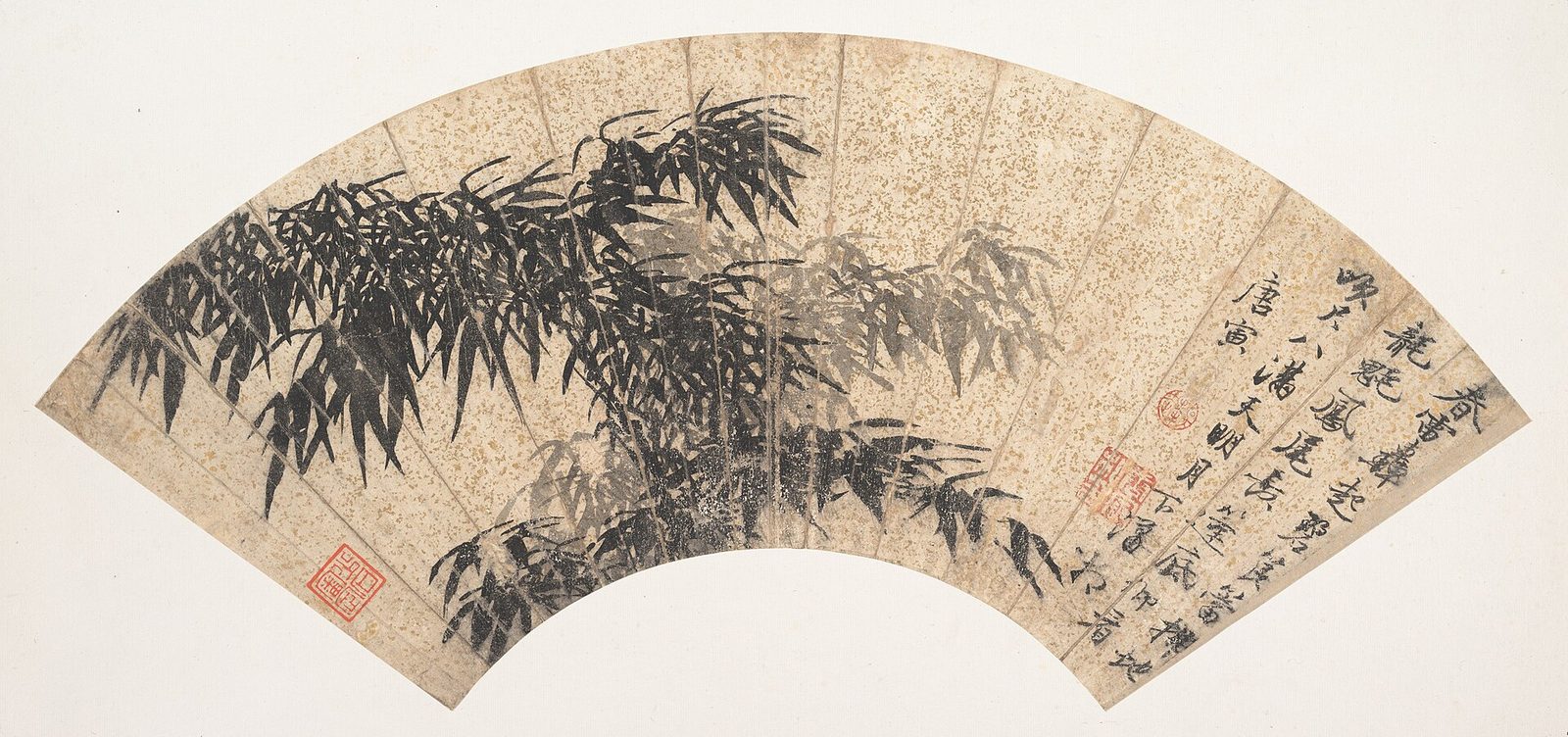
People like to say that “the spring wind comes like an honoured guest.”3 This one had no manners at all: it slammed the windows, snapped the bamboo, and broke up an honest sleep. I was in bed and ill, my throat so raw it felt like swallowing iron grit, unable to speak or laugh. Late, with the household quiet and sleep out of reach, I turned my ear to the wind instead. “A great wind rises, and the clouds go flying”4—that was the wind of the founder of Han, a hero’s wind. What we heard tonight was a commoner’s wind, and a lonely one. It did not sing; it wailed. It did not murmur; it roared. There was something in it of ghosts weeping, of wolves howling, of the sorrow of all the ages5 knotted together and past untangling. That night there was no lamp and no talk—only wind, and the drifting catkins;6 enough, truly, to make feeling follow after.7
I remembered reading Du Fu as a boy:8 “Boundless, the falling leaves come rustling down; endless, the long river rolls on and on.” I did not understand then what the wind meant. Tonight I felt something of it. Wind is the breath of heaven and earth: moving, it makes sound; quickening, it makes power. The ancients read the wind and knew the state of government;9 they listened to the wind and grasped the Way. In the Zhuangzi a man rides the wind and wanders free between heaven and earth.10 Su Shi floated at night below the Red Cliff, where the wind rose and the water surged, and life and death alike were emptied out.11 Tao Yuanming, retired to his southern hills, knew the pleasure of “clear wind and mild sun.”12 I am no sage, and what I grasped was slight: listening to the wind tonight only made me iller. Alas.13
A night wind differs from a day wind in three ways. The first is clarity—not the clarity of the human world, but the empty brightness of heaven and earth, in which every other sound has fallen away and the wind alone remains, like a sigh out of an empty valley. The second is distance: the wind keeps no fixed quarter and will not settle, so that it seems to blow in from the northern frontier one moment and out of the water-lanes of the south the next, until you cannot say where you are. The third is solitude: standing in the wind, you feel all at once how large the world is and how small you are. The faster the wind, the stiller the person—and the stillness is not sorrow. It feels more like being lifted out of the dust.
Some people hate the wind: it disturbs them, spoils their pleasure, chills them to the bone. Not I. Where the wind arrives, all things bow before it—such is its strength; where the wind has passed, the grass and trees revive—such is its kindness. The wind has no form and no constancy. It does not come for its own sake and will not stop for anyone’s. It looks about it and goes where its nature takes it.14 Is that not a kind of freedom?
The wind is still high tonight. The window paper shivers, the pages of my book turn themselves, dust lifts and catkins fly—all of it at the wind’s pleasure. I will not shut the window or cover my ears. I would rather sleep alongside the wind and let it hold forth all night. Call it, in sickness, a small clear blessing.
— Ill on a spring night, turning over and unable to sleep, I set down the wind to console myself.
-
From Li He’s “Song of the Governor of Yanmen” (Tang dynasty): “Black clouds press on the city till the walls give way; armour flashes towards the sun in golden scales.” The line originally describes a besieging army; here it borrows the menace for a gathering storm. ↩
-
The hour of midnight: the zi hour, roughly 11 p.m. to 1 a.m. in the traditional twelve-hour reckoning. ↩
-
From Yuan Mei’s “Spring Wind” (Qing dynasty): “The spring wind comes like an honoured guest—the moment it arrives, everything flourishes.” ↩
-
The “Song of the Great Wind,” attributed to Liu Bang, founder of the Han: “A great wind rises, and the clouds go flying; my might spread over all within the seas, I return to my home village. Where shall I find brave men to guard the four frontiers?” ↩
-
The sorrow of all the ages: from Li Bai’s “Bring in the Wine”: “Call the boy to take them out and trade them for fine wine, and with you I will drown the sorrow of ten thousand ages.” ↩
-
Catkins: willow and poplar down. In April the air over Beijing fills with it, so that wind and catkins arrive as a single phenomenon. ↩
-
Feeling follows after: from Wang Xizhi’s “Preface to the Orchid Pavilion Collection”: “Feelings shift as circumstances change, and emotion follows after them.” ↩
-
Du Fu (712–770), who lived for a time at Shaoling south of Chang’an and styled himself the Old Man of Shaoling. The lines quoted are from “Climbing the Heights.” ↩
-
Reading the wind: ancient states collected folk songs to gauge the temper of the people. The Book of Han records: “In antiquity there were officers who gathered songs, by which the king observed customs, learned his successes and failures, and corrected himself.” The same word covers both wind and the moral atmosphere of an age. ↩
-
A note on the original: the figure who rides the wind in the “Free and Easy Wandering” chapter is in fact Liezi—“Liezi rode upon the wind and went, cool and skilful, returning after fifteen days.” The essay names the book for the man. ↩
-
Su Shi below the Red Cliff: in his “First Rhapsody on the Red Cliff,” Su Shi drifts by boat on an autumn night and argues that “what passes away is like this river, and yet it has never gone,” and that “things and I are alike inexhaustible”—an equanimity about life and death reached by looking at what changes and what does not. ↩
-
Tao Yuanming (365–427), posthumously styled Master Jingjie. “The southern hills” recalls his most famous couplet: “Picking chrysanthemums by the eastern hedge, I catch sight, at my ease, of the southern hills.” The phrase “clear wind and mild sun” is a later formula for his temperament rather than a line of his own; the closest thing in his own work is “A light rain comes out of the east, and a good wind comes with it.” ↩
-
Alas: the classical exclamation jiefu, familiar from Fan Zhongyan’s “Record of the Yueyang Tower”: “Alas! I have sought to know the mind of the benevolent men of old…” ↩
-
Where its nature takes it: originally a Buddhist term, meaning to move with conditions as they come, without contrivance or discrimination. ↩