The year turns to Xuanying;1 the pitch pipes answer to Dalü.2
Cold and warmth work upon the heart;3 the ten thousand hollows cry out in the thickets.4 Heaven and earth shut fast,5 and hard frost seals the courtyard. At such a season the beast-shaped charcoal6 has burned low, and the cold bites all the sharper.7 The skin shrinks and shivers; the body flinches from the bleak wind and rain.
The piled quilts are cold as iron,8 and still I cling to their warmth; the pillow is high and all is level and safe9—no hour is better made for lying at ease.10 Why should leaning on the armrest11 wait upon a proper time? To draw a coarse hemp robe about oneself12 is loftiness enough.
The dream of Huaxu13 is short, yet it carries me beyond the world of things; the butterfly’s affection runs deep, and I cannot make out which of us is Zhuang Zhou.14 And so the red sun stands three poles high15 while my two eyes are still a blur.
Xihe whips on his horses,16 driving the daylight across an empty sky. Song Yu grieved for autumn17—was that some falsehood of the ancients? The truth is that the brush is frozen and hard to hold, and I am too idle to think up new verse.18 Sooner take after Zai Yu and bear the reproach of sleeping by day19 than learn the cock’s crow and set out for Hangu Pass.20
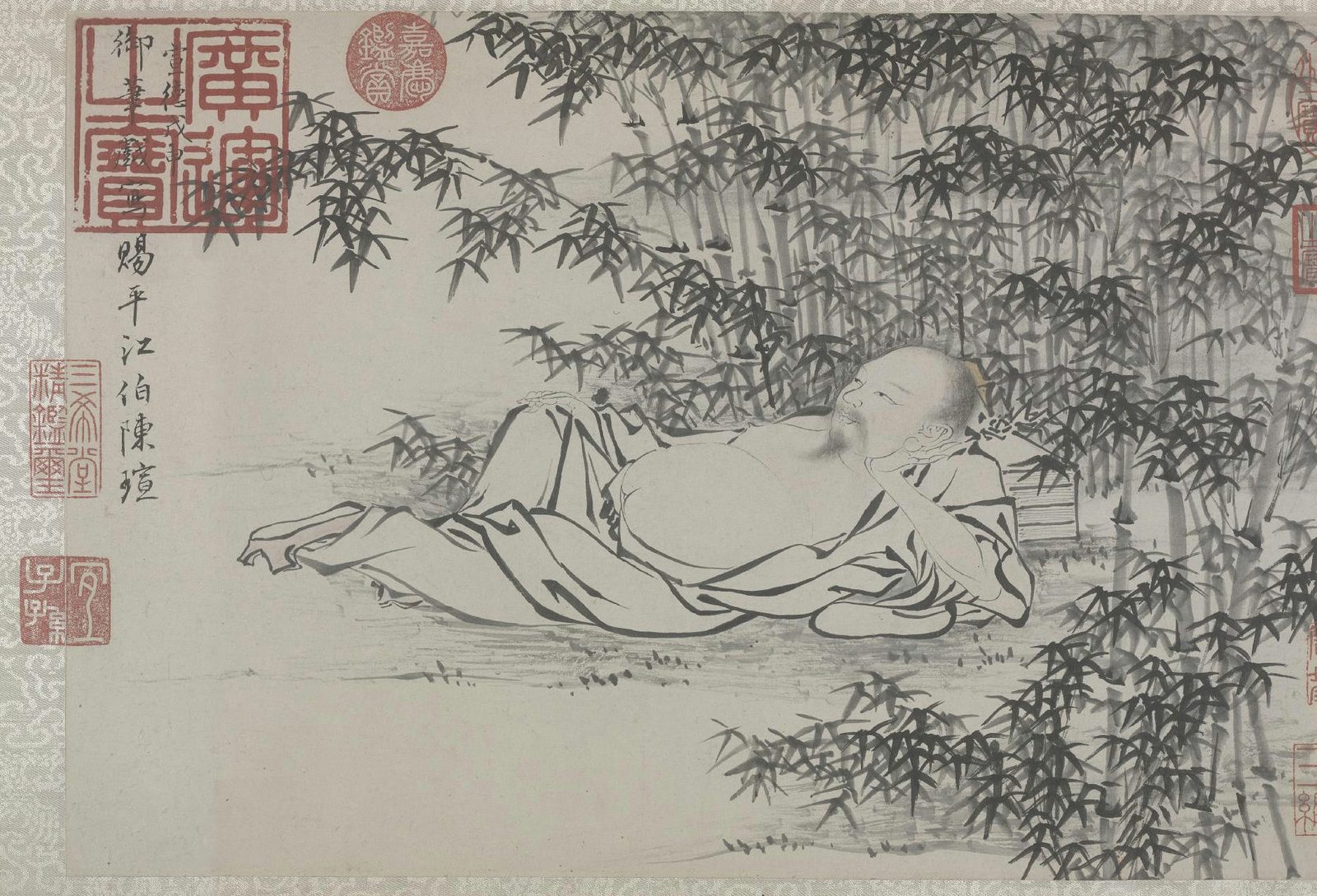
Master Ji was an idler: of his seven unbearables,21 rising early stood first. Chen Tuan the Recluse22 slept a thousand years and loved nothing but a drunken lie-down. Let the carriage dust beyond the gate rush where it likes, toiling and scurrying; the spring inside my quilt is mine, boundless and unhurried. Do not call me, do not summon me: this place is already Penglai.23 Envying nothing, wanting nothing,24 where I lie is Fangzhang itself.25 Let me take this body and quit the dusty net26 a while. When the warm pipes bring back the spring, then I shall straighten my robe and take my place again.27
-
Xuanying: a classical name for winter. The Erya, in the chapter “Explaining Heaven,” states simply: “Winter is Xuanying.” ↩
-
Dalü: one of the twelve pitch pipes of ancient Chinese music. The twelve pipes were matched to the twelve months; the “Monthly Ordinances” chapter of the Book of Rites assigns Dalü to the last month of winter. The line therefore places us at the depth of the year. ↩
-
Cold and warmth work upon the heart: from Zhang Heng’s “Rhapsody on the Western Capital” (2nd century CE): “In the season of yang a person expands; in the season of yin a person is downcast.” ↩
-
The ten thousand hollows: from the Zhuangzi, “On the Equality of Things”: “The Great Clod belches out breath, and its name is wind… when it blows, the ten thousand hollows roar.” The word rendered “thickets” comes from the Chuci. ↩
-
Heaven and earth shut fast: the Book of Rites describes the first month of winter: “The vapours of heaven ascend, the vapours of earth descend; heaven and earth no longer communicate, and, closing up, they make winter.” ↩
-
Beast-shaped charcoal: charcoal dust moulded into animal shapes, a luxury of wealthy households. The Book of Jin records that Yang Xiu “ground charcoal and moulded it into the shapes of beasts to warm his wine,” after which the fashion spread among the grandees of Luoyang. ↩
-
The original word for the sharpness of the cold also means grief or pain: the fire dies down, and the cold becomes not merely colder but harder to bear. ↩
-
Cold as iron: an echo of Du Fu’s “Song of My Thatched Roof Torn Apart by the Autumn Wind”: “My cloth quilt, years old, is cold as iron.” Du Fu wrote out of real poverty; here the line is turned on its head to describe attachment to a warm bed. ↩
-
A high pillow: to sleep with one’s head high, that is, without anxiety—a phrase found in the Strategies of the Warring States. ↩
-
Lying at ease: the phrase comes from the Book of Songs, “Northern Mountain”: “Some rest and lie at ease; some are burdened with the king’s affairs.” ↩
-
Leaning on the armrest: from the Zhuangzi: “Ziqi of the Southern Wall sat leaning on his armrest, gazing up at heaven and breathing out.” ↩
-
A coarse hemp robe: the short rough garment of the poor. Wearing it and feeling exalted rather than ashamed is the classical posture of the recluse. ↩
-
Huaxu: in the Liezi, the Yellow Emperor falls asleep by day and dreams of travelling to the land of Huaxu, a realm of effortless nature whose people have no cravings. The name came to stand for the dream world itself. ↩
-
The butterfly: the Zhuangzi again: “Once Zhuang Zhou dreamt he was a butterfly… He did not know whether he was Zhuang Zhou who had dreamt he was a butterfly, or a butterfly dreaming that he was Zhuang Zhou.” ↩
-
Three poles high: the sun already well up—an idiom for rising very late. ↩
-
Xihe: the charioteer who drives the sun across the sky. In the Li Sao, Qu Yuan commands: “I bid Xihe slacken the pace, and, nearing Yanzi Mountain, not to press on.” ↩
-
Song Yu grieved for autumn: the Jiu Bian, attributed to the Warring States poet Song Yu, opens: “How mournful is the air of autumn! Bleak and chill, the plants shed their leaves and decay.” It is the fountainhead of autumn-grief in Chinese poetry. The rhapsody asks, with a straight face, whether autumn was ever the worst of it. ↩
-
The frozen brush: from Li Bai’s “Returning to My Old Mountain on a Winter Day”: “The brush is frozen, and I am too idle to write new verse; the stove is cold, though good wine is warmed from time to time.” ↩
-
Zai Yu: a disciple of Confucius. The Analects records: “Zai Yu slept by day. The Master said: rotten wood cannot be carved, and a wall of dung cannot be plastered.” Sleeping by day has been a byword for sloth ever since. ↩
-
The cock’s crow at Hangu Pass: the Records of the Grand Historian tells how Lord Mengchang, fleeing Qin, reached Hangu Pass at midnight, where the law allowed travellers out only after the cock crowed. A retainer skilled at imitating cocks set every rooster in the district crowing, and the gate was opened. The rhapsodist declines to imitate anyone in order to get an early start. ↩
-
Seven unbearables: in his “Letter Breaking Off Relations with Shan Tao,” Ji Kang lists seven things he could not bear about official life. The first: “I like to lie in and rise late, but the gatekeeper would go on calling me—the first thing I could not bear.” ↩
-
Chen Tuan (d. 989): a hermit of the Five Dynasties and early Song, granted the title “Master Xiyi” by Emperor Taizong. Legend made him a prodigious sleeper who could sleep for months on end; later tradition calls him the Sleeping Immortal. The “thousand years” is deliberate hyperbole. ↩
-
Penglai: one of the three fabled isles of the immortals in the eastern sea, named in the Records of the Grand Historian. ↩
-
Envying nothing, wanting nothing: from the Book of Songs, “The Male Pheasant”: “Envying nothing, seeking nothing—how could he be anything but good?” ↩
-
Fangzhang: another of the three immortal isles; the word also means a room ten feet square. The pun makes the narrow bedroom and the paradise the same place. ↩
-
The dusty net: worldly entanglement. Tao Yuanming: “By mistake I fell into the dusty net, and thirty years went by.” ↩
-
The warm pipes: the ancients watched the pitch pipes for the return of yang vapour in spring. The closing phrase, coined by the author, means to dress properly at last and rejoin the roll of the working world. ↩