Autumn air fills the flat and darkening sky;1
cold mist rises from the evening shoal.2
Dust lifts with every fold of cloth;
sweat runs clear in the noonday sun.3
A thin fate:4 bitter, year upon year.
A kind heart: light with every step.
Long I sigh that heaven and earth are so generous,
and cannot save one body from its poverty.5
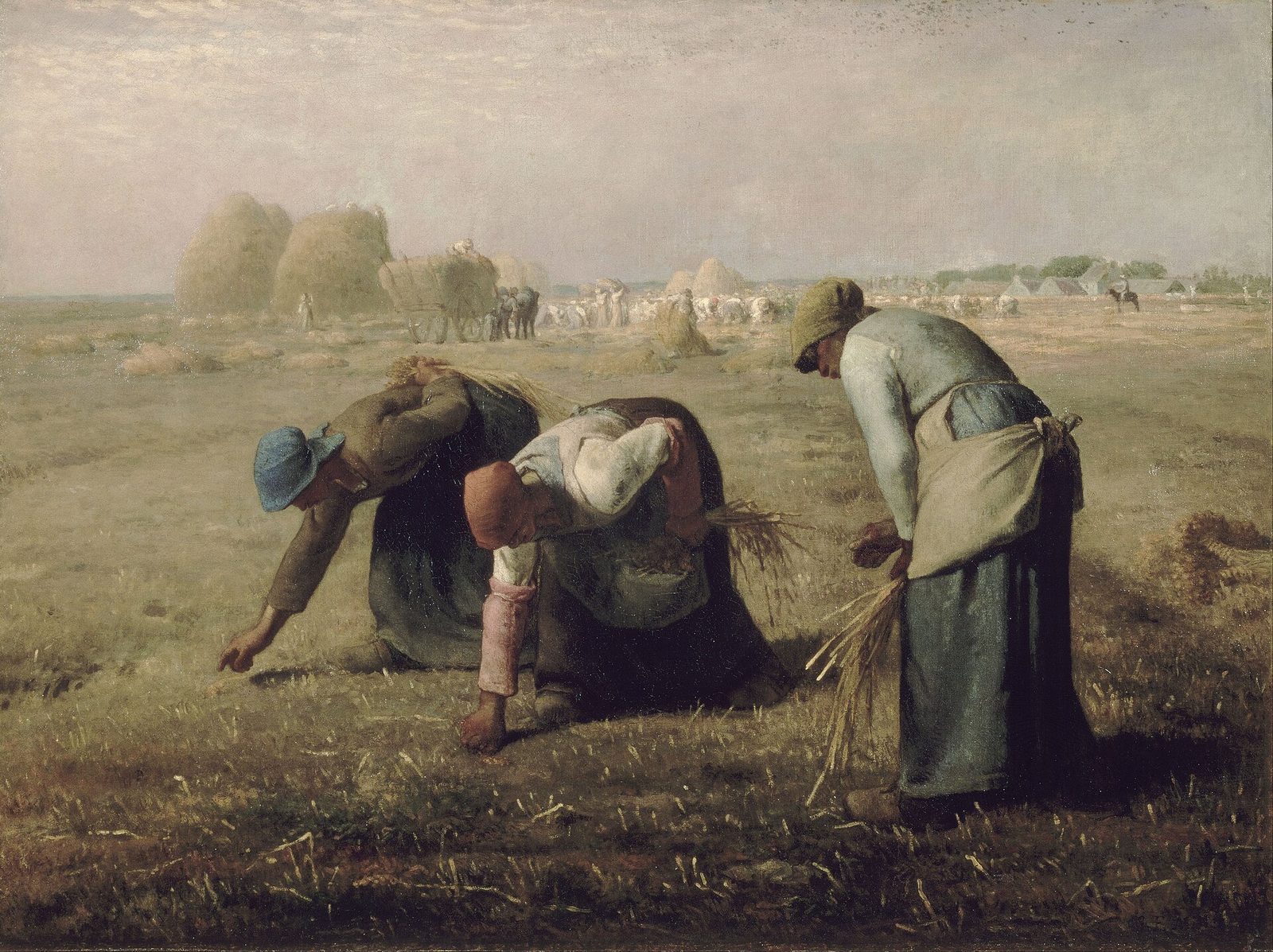
I once travelled to Minzu University of China6 to sit the Beijing municipal humanities competition. The set subject was a painting of gleaners,7 and I wrote a poem in five-character regulated verse with the rhyme fixed in advance.8 It was finished in haste, with no time to polish it.9 Opening the sheet again today, I have touched it up a little, in the hope10 of not falling short of what I meant that day.
-
The flat and darkening sky: the original compounds “level” with a word meaning dim, deep, remote—the whole expanse of sky above open country, filling with autumn. ↩
-
Shoal: the flat ground at the water’s edge, or a small islet in a stream. The line sets the hour: the mist rising off the water at dusk, cold arriving before the dark. ↩
-
The couplet is built on a reversal: dust rises and clouds the clothes; sweat pours in the midday heat and leaves the body clear. One line turbid, one clear; one rising, one washing away. ↩
-
A thin fate: a humble station and a hard livelihood. ↩
-
The closing couplet: the covering virtue of heaven and earth could hardly be called anything but generous, and yet it cannot lift a single person out of poverty. The compassion is close to Du Fu’s wish for “a mansion of ten thousand rooms, to shelter every poor scholar beneath heaven,” but put as a question, and sharper for it. ↩
-
Minzu University of China: on South Zhongguancun Street in the Haidian district of Beijing. ↩
-
Gleaning: gathering the ears of grain left behind after the harvest, on which the poor once depended. The classic treatment is Bai Juyi’s “Watching the Wheat Harvest” (Tang dynasty): “And there is a poor woman too, her child held at her side—in her right hand the fallen ears, on her left arm a broken basket.” The title of this poem, “Watching the Gleaners,” is formed directly on Bai Juyi’s. ↩
-
A fixed rhyme: examination poems and poetry contests traditionally specified the rhyme group a poem had to use throughout, with departures counted as faults. Here the rhyme group was the one containing the character qing, “clear.” ↩
-
The word rendered “no time” literally means leisure: there was none. ↩
-
In the hope: a classical particle of tentative wishing, familiar from Mencius: “If Your Majesty’s love of music is as great as this, the state of Qi is perhaps not far from good order.” ↩